

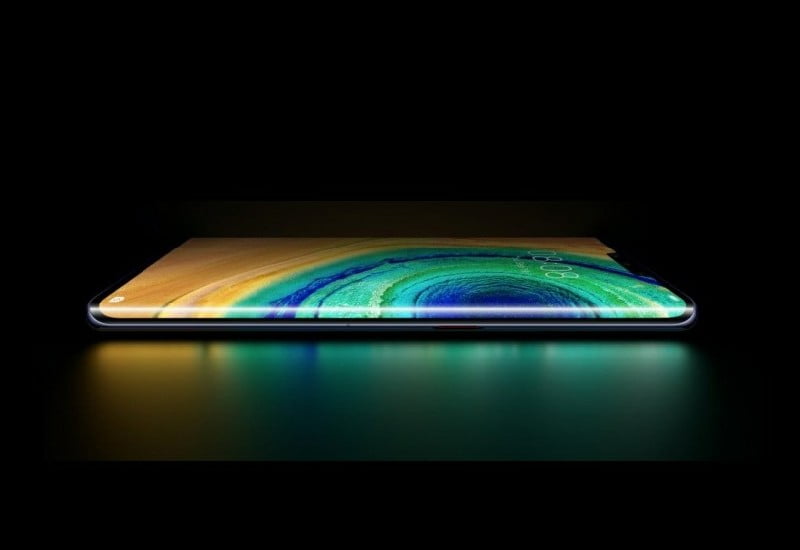
After a lot of hype and leaks, the Huawei Mate 30 and Mate 30 Pro are now official. These are the most anticipated flagships of Huawei because of their ban on US/China issues. This Mate 30 series is going to decide the future of Huawei, because at least in China they are going to launch this without Google services. Don’t worry it will run on Android 10 out of the box, but the Play Services and Google apps won’t be available for China. Now let’s have a look at what Huawei brings for both Mate 30 and Mate 30 Pro.

Huawei Mate 30 Pro:
Starting off with the Pro variant, it sports a 6.53 inch OLED display with Quad HD+ (2400×1170) and 403 pixel density (ppi). It’s an HDR10 display with 100% DCI-P3 colour gamut. It has a screen to body ratio of 94.1% and the sides are curved at 88°, similar to what we have seen in recently unveiled Vivo NEX 3. And just like NEX 3 this one also has touch sensitive buttons for power and volume rocker. And for protection both front and back has Gorilla Glass 6 on top.


It comes with HiSilicon Kirin 990 octa core chipset clocked at 2.86Ghz and built on 7nm process. For graphic tasks it has Mali G76 MP16 GPU with enhanced GPU Turbo. A Graphene sheet is inside to cool down the chipset and GPU during intense tasks. It has 8GB of RAM with 128/256GB of UFS 3.0 internal storage with Nano memory card for expandable storage up to 256GB.
Moving to the camera, Huawei rocked in terms of hardware (at least on paper). On the rear, it has a triple camera setup along with 3D ToF sensor. The primary one is a 40MP lens with f/1.6 aperture, OIS, and PDAF. The secondary one is a 40MP wide-angle lens with f/1.8 aperture, OIS and PDAF. Lastly, the third one is 8MP telephoto lens with f/2.4 aperture, 3x optical zoom, 5x optical hybrid zoom, OIS, and PDAF. It can now record videos up to 4K at 60fps (first for any Huawei phone).
There’s 4K Timelapse with HDR+ as well, which seems interesting to look into. For low light videos, it can go as high as 4,09,600 IOS. Now the most surprising element, the slow motion. It can record slow-motion videos at 720p resolution with never seen before 7680fps. As of now, 960fps is highest for any smartphone and now Huawei has taken such a big jump here. Excited to see the samples. At the front, there’s a 32MP lens along with 3D face scanning hardware for secure face unlock.
It runs on Android 10 out of the box with EMUI 10 on top. As the Google services are not available here, Huawei has its own app store which will develop a lot now. It packs in a 4,500 mAh battery with 40W fast charging and 27W wireless fast charging. It’s IP68 certified for dust and water resistance. The fingerprint sensor is present under the display.
Also, there’s a stereo speaker setup for immersive sound. For connectivity, it has 5G, dual band Wi-Fi, Bluetooth 5.1, GPS, aptX HD, NFC, infrared sensor, and Type-C port. It comes with Black, Silver Space, Cosmic Purple, and Emerald Green colour options.
Huawei Mate 30:
There aren’t much of the difference between both, so I am going to point out only the differences here and not the whole spec sheet. It sports slightly larger 6.63 inch OLED display with toned down Full HD+ (2340×1080) resolution and 389 pixel density (ppi). Also this is a flat display, not curved like the Pro. Rest other display qualities are same. It has 8GB of RAM but only 128GB UFS 3.0 internal storage option.

The primary camera is same 40MP lens but with f/1.8 aperture now. The wide angle lens is down to 16MP here. The slow motion is back to 720p at 960fps here. The front camera is also scaled down to 24MP and without 3D sensor. Rest other camera specs are the same. The Mate 30 packs in a slightly smaller 4200mAh battery with same fast charging as the Pro. It retains the 3.5mm headphone jack. Rest other specs are same as the Mate 30 Pro.
Pricing & Availability:
- Mate 30 : €800 (approx. ₹63,080)
- Mate 30 Pro 4G (256GB) : €1,100 (approx. ₹86,735)
- Mate 30 Pro 5G (256GB) : €1,200 (approx. ₹94,620)
- Pre-orders in China will start from tomorrow, shipping starts from 28th September.
- Will be available globally sometime in October.
So that’s all the information we have as of now. I personally found the camera hardware to be the best in Mate 30 Pro. But it would be interesting to see how well the camera performs in real life. Also, it’s still a question whether the Global variant will have Google services or not. What are your thoughts on both Huawei Mate 30 and Mate 30 Pro? Let us know in the comments section below. Also, stay tuned with us for more information.

Read interesting news, reviews as well as tips & tricks on TechnoBugg website, and stay updated with the latest happenings of tech world on the go with Technobugg App.

